
**ADM2914-1ARQZ: A Comprehensive Guide to its Function and Circuit Design**
In the realm of modern electronics, ensuring system stability and protecting hardware from potentially damaging conditions is paramount. The **ADM2914-1ARQZ** stands as a critical component in this protective architecture, a sophisticated **supervisory circuit** designed to monitor power supply voltages and control system sequencing. This integrated circuit (IC) is essential for applications ranging from servers and telecom hardware to industrial control systems, where reliability cannot be compromised.
**Primary Function and Operating Principle**
The core function of the ADM2914-1ARQZ is to monitor one or more system power supply voltages and assert a reset signal if any of them deviate from their specified safe operating range. This prevents a microprocessor or FPGA from operating with insufficient voltage, which can lead to erratic behavior, data corruption, or even hardware damage.
The IC operates by comparing the monitored voltage (VCC) against a precise internal reference. The **ADM2914-1ARQZ features a fixed voltage threshold of 2.93V**, making it ideal for monitoring 3.3V and 3V power rails. When VCC falls below this threshold, the active-low RESET output is asserted. Crucially, it remains asserted for a fixed period (typically 240 ms) after VCC has risen back above the threshold, ensuring the power supply and system clock have stabilized before the processor begins operation. This **time-delayed reset release** is a fundamental feature for guaranteed system stability upon power-up, power-down, or during brownout conditions.
**Key Internal Circuitry and Pin Configuration**
Housed in a compact 8-lead SOIC package, the ADM2914's design integrates several key blocks:
1. **Voltage Reference:** A highly stable bandgap reference circuit that provides the baseline for accurate voltage comparison.
2. **Comparator:** The heart of the device, it continuously compares the scaled VCC against the internal reference.
3. **Reset Time Delay Generator:** An internal timer that controls the duration of the reset pulse after the voltage conditions have been met.
4. **Output Driver:** A push-pull output stage that provides a clean, digital RESET signal capable of directly driving microprocessor reset pins.
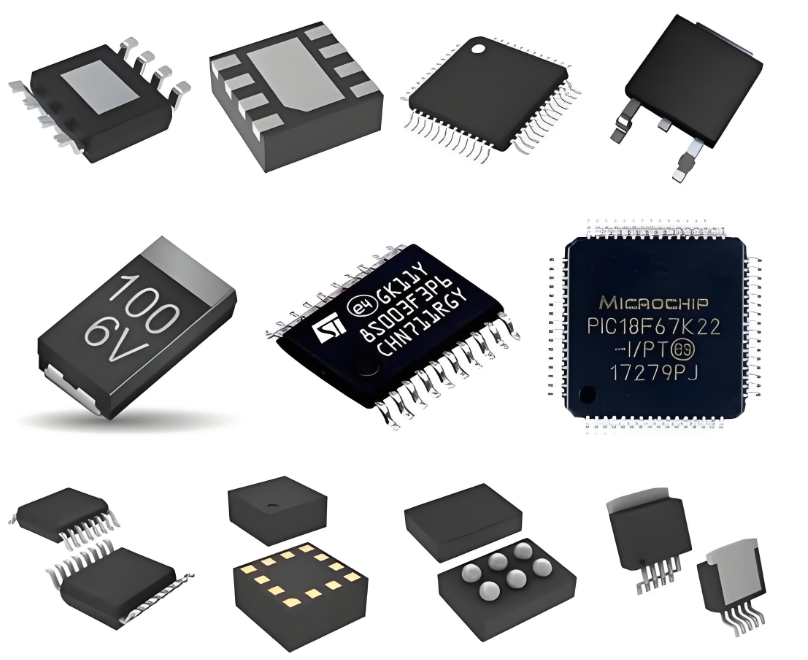
The critical pins for basic operation are:
* **VCC:** The power supply pin connected to the rail being monitored (e.g., 3.3V).
* **GND:** Ground connection.
* **RESET:** Active-low reset output. It is driven low when VCC is out of tolerance and for the fixed delay period afterwards.
**Essential Circuit Design Considerations**
Implementing the ADM2914-1ARQZ in a design is straightforward, but attention to detail ensures optimal performance.
1. **Power Supply Decoupling:** A **0.1 µF ceramic decoupling capacitor** must be placed as close as possible to the VCC and GND pins. This is non-negotiable, as it filters high-frequency noise on the supply line that could otherwise cause false reset triggers.
2. **Connecting to the Microprocessor:** The RESET output is typically connected directly to the active-low reset pin of the microprocessor or logic device. A **10 kΩ pull-up resistor** is not required for this specific push-pull output variant, simplifying the design.
3. **Manual Reset Capability (MR Input):** Many supervisory circuits, including some in the ADM2914 family, feature a Manual Reset input. This allows an external switch or another logic signal to force a system reset. While the base ADM2914-1ARQZ may not include this feature, if present, the MR pin should be pulled high to VCC via a resistor (e.g., 10 kΩ) and connected to a push-button switch that pulls it to ground when activated. **Proper debouncing** of the mechanical switch, often with a small capacitor (0.1 µF), is recommended to prevent glitches.
4. **Board Layout:** As with all precision analog circuits, keeping traces short, especially from the decoupling capacitor to the IC, is critical. Avoid running noisy digital or switching power supply lines near the monitor's inputs.
**ICGOODFIND**
The **ADM2914-1ARQZ** is an indispensable component for designing robust and reliable electronic systems. Its ability to accurately monitor power supply integrity and provide a guaranteed reset signal simplifies the design process and acts as a first line of defense against unpredictable system behavior. By adhering to fundamental circuit design practices—particularly effective power decoupling and clean board layout—designers can fully leverage this IC's capabilities to create products that perform consistently under real-world power conditions.
**Keywords:** Power Supply Monitor, Supervisory Circuit, Voltage Threshold, Reset Generator, Brownout Protection

